

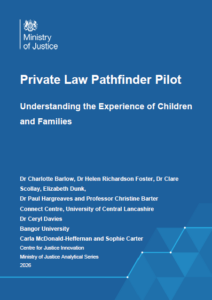
The Ministry of Justice has published new research examining the Private Law Pathfinder Courts pilot, offering important insight into how children and families experience this reformed approach to private law proceedings. Zoe Brettle, from our Family Law Team in Birmingham, considers the findings and their practical impact on private law cases.
For family law practitioners, the findings are highly relevant. They speak directly to issues GT Stewart Solicitors sees daily:
- child participation,
- domestic abuse,
- safeguarding,
- delay,
- the emotional impact of proceedings on families.
For full access to the PDF, click below.
A shift towards a child‑centred, investigative approach
The Pathfinder pilot, introduced in Dorset and North Wales, replaces the traditional Child Arrangements Programme (CAP) with a more investigative, child‑focused and multi‑agency model.
Its aims include:
- centring the voice of the child at an earlier stage,
- improving responses to domestic abuse and safeguarding concerns,
- reducing delay and the number of repeat applications,
- limiting the re‑traumatisation often experienced by families in private law proceedings.
These are ambitions GT Stewart has long supported in its family law practice, particularly where vulnerable parents and children are involved.
What families told the researchers
The research is based on interviews with 39 parents and carers and nine children, providing a detailed picture of lived experience rather than headline statistics.
Children’s voices are being heard more clearly
One of the strongest findings is the improvement in how children are engaged. Most children felt listened to by Cafcass or Cafcass Cymru, and parents reported that Child Impact Reports helped ensure children’s wishes and experiences were captured earlier and more meaningfully than under CAP.
For families who had previously been through private law proceedings, this was seen as a genuine improvement.
Greater involvement of domestic abuse services
Many parents, particularly mothers, welcomed the direct involvement of specialist domestic abuse services, describing this as 'a significant step forward'. Support ranged from emotional and practical assistance to help with special measures and court attendance.
This reflects a growing recognition that private law proceedings must be handled through a trauma‑informed lens.
More efficient proceedings
Parents with experience of both systems generally felt that Pathfinder was quicker and more streamlined, reducing the number of hearings and overall delay.
Where challenges remain
The research also highlights important shortcomings that practitioners and policymakers must continue to address.
Inconsistent protection for domestic abuse survivors
While some parents benefited from special measures and DASH risk assessments, these were not consistently offered or implemented. Several parents felt their experiences of abuse were minimised or not fully understood by professionals, particularly within court hearings.
Feeling believed and having experiences validated emerged as central to whether proceedings felt protective or re‑traumatising.
Mixed experiences with judicial decision‑making
Parents’ experiences of judges and magistrates varied widely. Some felt listened to and supported; others, particularly domestic abuse victim‑survivors, felt pressured to prioritise co‑parenting despite ongoing safety concerns.
Clear communication about how and why decisions are reached was repeatedly identified as an area for improvement.
Limited follow‑up after final orders
Although Pathfinder originally included a review stage, most parents reported that no follow‑up or ‘check‑in’ occurred, leaving some families feeling unsupported once proceedings concluded.
What this means for families and practitioners
The MoJ research confirms that Pathfinder is a positive step forward, particularly in amplifying children’s voices and improving early information‑gathering. However, it also reinforces that structure alone is not enough.
Consistency, training, communication and a trauma‑informed culture remain essential.
At GT Stewart Solicitors, our Family Law team regularly supports parents navigating private law proceedings – including cases involving domestic abuse, safeguarding concerns and complex child arrangements. This research reflects many of the challenges our clients face and underlines the importance of early legal advice, clear advocacy and child‑focused representation.
Talk to our Family Law team
If you are involved in private law proceedings or have concerns about child arrangements, domestic abuse or safeguarding, our specialist Family Law solicitors can help.
Contact the Birmingham Family Law Team (Corporation Street, Birmingham)
0121 643 4121
www.gtstewart.co.uk